
Does Teeth Whitening Powder Work?
Whitening powder may help with surface stains. The formula and type of discolouration matter. Here is what to check before choosing one.
Shop Whitening Products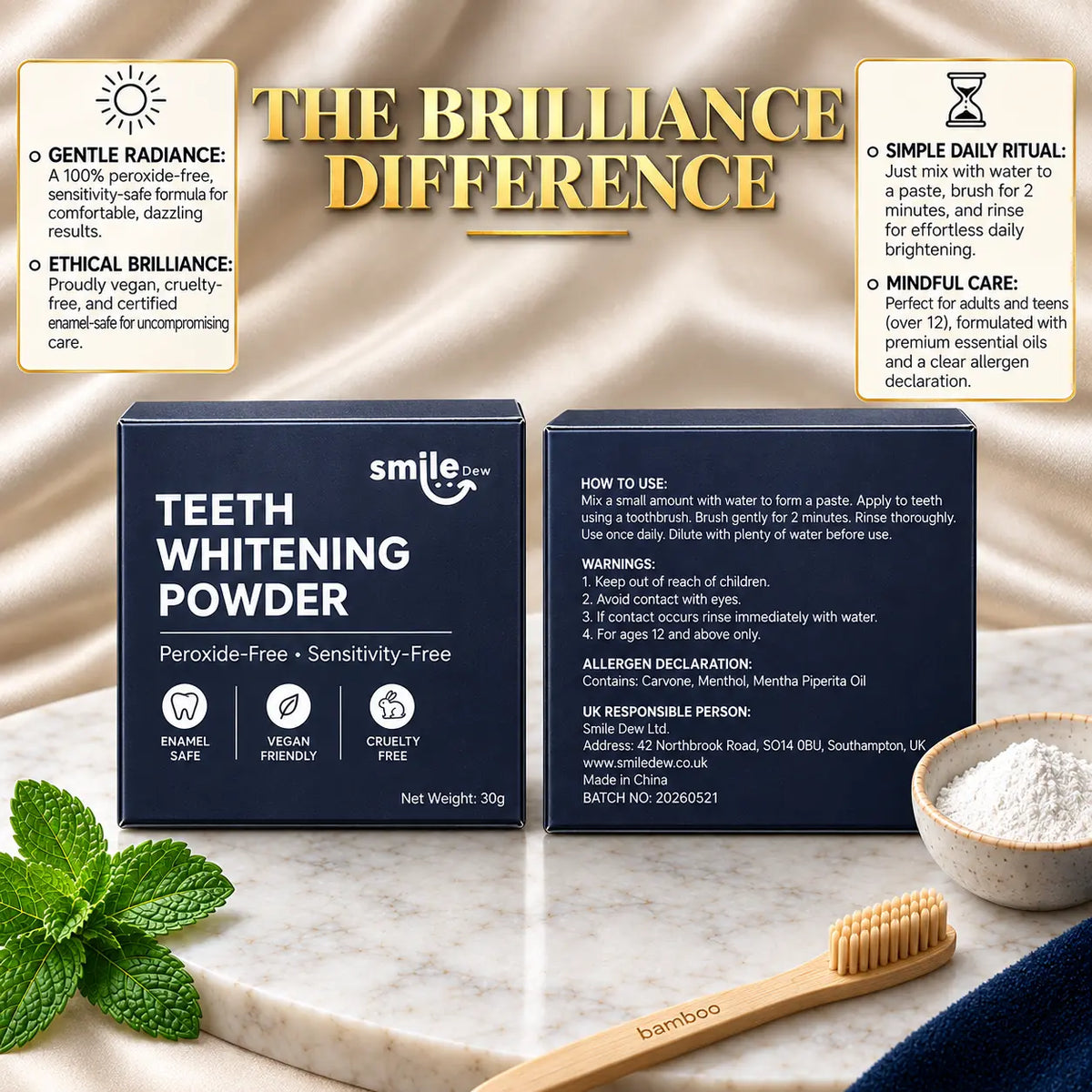
How does teeth whitening powder work?
Coffee, tea and red wine can leave stains on the outside of teeth. A whitening powder may help address that surface staining, but “powder” describes the format, not one standard formula.
The American Dental Association explains that external stains and colour changes within a tooth are different. A product intended for surface stains cannot be assumed to change deeper tooth colour.
Surface cleaning and whitening ingredients
Some formulas contain cleaning or polishing ingredients. Others also contain a whitening agent. Check the ingredient list rather than assuming all powders work like charcoal.
Smile Dew lists calcium carbonate and sodium bicarbonate alongside 4% PAP. An ingredient list alone does not tell you the finished product's abrasiveness or prove how much it will change your tooth shade.
What does PAP mean?
PAP stands for Phthalimidoperoxycaproic Acid. It is an oxidising whitening ingredient used in some oral care formulas.
A published laboratory study of a PAP gel investigated whitening on extracted teeth. It studied a different finished formula and had authors affiliated with that brand's research centre.
Those findings do not establish how Smile Dew powder performs in everyday use. The complete formula, concentration and application method matter when assessing a product's evidence.
What results can you realistically expect?
Start with the problem you want to address. Everyday surface staining is different from naturally darker teeth or a change in colour within one tooth.
If you are unsure what is causing discolouration, a dentist can help you identify it before you choose a whitening product. That can save you buying something intended for a different concern.
How long does teeth whitening powder take to work?
There is no single results timetable for every whitening powder. Your starting shade, staining and the finished formula can affect what you notice.
Smile Dew's two minute brushing instruction is an application time, not a promise of visibly whiter teeth in two minutes. There is no fixed shade improvement or guaranteed results date in this guide.
If you compare photographs, keep the lighting, angle and camera settings consistent. Do not use more powder or brush harder to chase a quicker change.
Whitening powder, charcoal and toothpaste compared
Choose by the role a product plays in your routine. A whitening step and everyday fluoride brushing serve different purposes.
| Option | What to check | Routine and main limitation |
|---|---|---|
| PAP whitening powder | PAP concentration, complete ingredients, directions and evidence for the finished formula. | Usually an additional step. Smile Dew is mixed with water and used according to its own directions. It does not replace fluoride toothpaste. |
| Charcoal whitening powder | The complete formula, abrasiveness information and any product-specific evidence. | Do not assume charcoal means gentler, more effective or suitable for daily use. Follow that product's directions. |
| Fluoride whitening toothpaste | Fluoride content, directions and the whitening claims of the particular toothpaste. | Can combine everyday fluoride brushing with surface stain cleaning. Formulas vary and it should not be treated as equivalent to every whitening treatment. |
There is no automatic winner for everyone. If you want a powder without charcoal, compare the listed ingredients. If you want to maintain your everyday brushing routine, keep fluoride toothpaste in it.
Prefer an applied format instead? Read whether teeth whitening strips work or explore the Smile Dew whitening pen. Different formats have different directions, so do not combine their routines by guesswork.
What should you check before buying?
Ingredients and evidence
Look beyond one highlighted ingredient. Read the full formula and check whether supporting research tested that exact product, a different formula or only an ingredient.
Smile Dew's 30g powder contains 4% PAP, hydroxyapatite and xylitol, with no charcoal or added alcohol. These are formula details, not a guarantee of results or freedom from irritation.
Suitability and sensitivity
The NHS advises that dentist-provided whitening is the safest route. If you have sensitive teeth, gum problems or dental work, ask your dentist before adding a whitening product.
Stop using a product if pain or irritation occurs. This guide is for adults; the NHS advises against teeth whitening for under 18s and during pregnancy or breastfeeding.
Pack size and real value
A larger pot is not automatically better value. You also need a reliable amount per application to compare cost per use.
A 30g pack does not, by itself, prove a certain number of treatments. Check the current price and details on the Smile Dew Teeth Whitening Powder page before deciding.
How do you use Smile Dew teeth whitening powder?
Follow the supplied directions for your pack. The Smile Dew routine is a separate powder step, with water used to make a light paste.
- Mix a small amount with water. Make a light paste as directed.
- Brush gently for two minutes. Wet your toothbrush first and use light pressure.
- Rinse thoroughly. Rinse your mouth and toothbrush after the powder step. Follow the supplied once daily directions.
A soft bristle toothbrush is available in the Smile Dew range if you need a brush for your routine. Brushing harder is not a shortcut to a better result.
Keep your fluoride toothpaste routine
The powder is an optional additional step. Keep brushing with fluoride toothpaste twice daily; NHS guidance recommends brushing for about two minutes and spitting without rinsing after toothpaste.
The rinse instruction above applies to the powder step. It is not an instruction to rinse away your fluoride toothpaste. Ask your dentist how to fit an extra whitening step into your routine if you are unsure.
Frequently asked questions
Can I mix whitening powder into my toothpaste?
Do not assume you can. Instructions vary between brands. Smile Dew's directions say to mix the powder with water, so follow those directions rather than a different product's routine.
Can I use teeth whitening powder every day?
Follow the specific product's frequency. Smile Dew's supplied directions are once daily. That does not mean every powder has the same schedule or that it suits every person.
Will whitening powder change crowns, veneers or fillings?
Do not expect dental restorations to whiten like natural teeth. The NHS explains this limitation. Ask your dentist about an uneven shade before choosing a product.
Is whitening powder better than strips?
The format alone does not establish which works better. Compare the complete formula, directions, suitability and evidence for each product, then choose the routine you can follow properly.
How long does a 30g pot last?
That depends on the amount used each time. Without a verified application quantity, there is no reliable treatment count to promise. Use the directed amount rather than adding extra powder.
Choose a formula you understand
If you are comparing powders for everyday surface stains, start with clear ingredients and directions. Smile Dew offers a 30g formula with 4% PAP, hydroxyapatite and xylitol.
What you are choosing:
- A separate brushing step: Mix with water and follow the supplied directions.
- A clearly listed formula: Check the complete ingredients before buying.
- No charcoal or added alcohol: Compare features that matter to your preference.
- A choice you can check: Review suitability information and current pack details on the product page.
View Smile Dew Teeth Whitening Powder
Still choosing a format? Compare the Smile Dew range and check the UK delivery policy before you order.